
Compare Pratt County Property Value Types
Know which number is on the table before you compare a Pratt County parcel with a sale or a neighboring property. Kansas classification rules make fair market value and assessed value distinct, so mixing them invites false conclusions in any property records lookup.
| Value | What It Is | Where |
|---|---|---|
| Fair market value | Appraiser's January 1 estimate under Kansas standards | Annual notice or Appraiser data |
| Assessed value | Classification ratio applied for taxation | Assessment record |
| Sale price | Amount associated with one transaction | Comparable-sales or transfer record |
| Land and improvements | Components explaining the total estimate | Appraiser report |
Assessed value is not the full fair market value. Kansas runs a countywide ratio study as a performance measure, and that ratio should never be applied as a discount to one property's appraisal.
Pratt County Values Use a January 1 Date
The Pratt County Appraiser fixes the value date at January 1. Notices usually go out near March 1. Inspections run on a six-year cycle, and the office reviews market evidence every year. New construction, demolition, condition, and recent sales can all move the estimate.
That date label carries real weight. A later improvement or market shift cannot change what an assessment was built to measure. The Appraiser determines value. The Clerk sets levy context, and the Treasurer collects the bill that follows.
Note: Value figures belong here. Tax bills, exemptions, and appeals sit with the Pratt County property-tax records.
Pratt County Compares and Adjusts Five Sales
The county's adjusted-sales guidance covers the local method. It says the Appraiser typically weighs five comparable sales. The Appraiser then adjusts each for differences against the subject property. A comparable-sales sheet can pack in a lot. Main and upper-floor living area, beds and baths, HVAC, basement finish, quality, condition, garages, porches, decks, land value, building cost, other improvements, sale date and price, adjusted sale, prior value, market value, indexed value, and distance points may all appear. That beats copying a nearby sale price. Adjustments account for the gaps between the subject and each comparable. The official comparable-sales report page explains every field used in the local analysis.
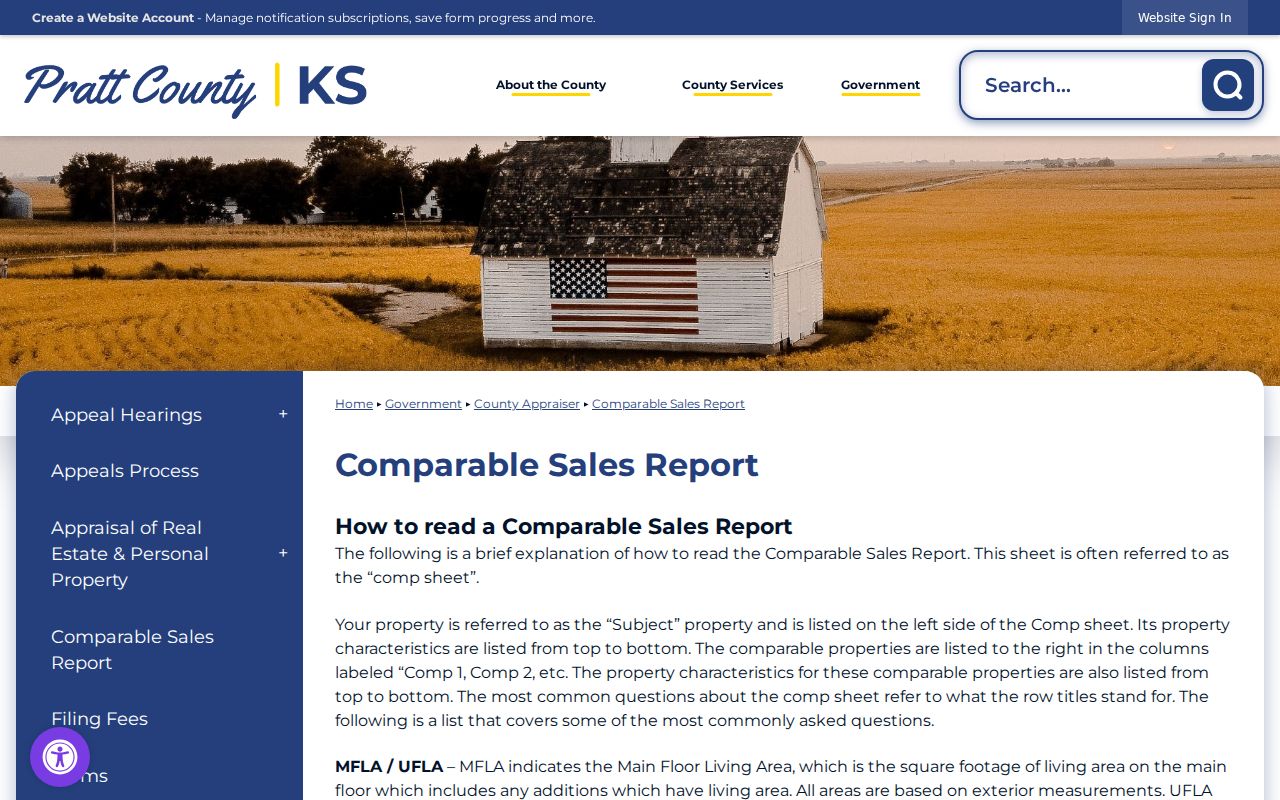
Treat the report as evidence behind an appraisal, not a promise that the parcel would sell for the weighted figure on the sheet.
Read Pratt County's 2026 Market Study Carefully
The Appraiser's 2026 market-study statements describe local trends by property class and market segment. They steer annual appraisal work. But a countywide or neighborhood trend never dictates the same change for every parcel. Condition, size, use, quality, location, and qualified sales still drive the outcome. Agricultural land follows use-value rules rather than a residential sales comparison, so keep class and use explicit whenever two Pratt County property values are compared. Never carry a residential percentage over to cropland or commercial ground.
Look Up a Pratt County Assessed Value
Pratt County publishes no public parcel-card link for individual property records. Request data from the County Appraiser by address or parcel number, and ask for the value year and component labels.
- Provide the situs address and exact parcel number.
- Request current and prior market value, assessed value, and land/improvement components.
- Record the January 1 valuation year and response date.
- Ask for a comparable-sales report when the evidence matters.
- Keep sale price separate and note whether the transaction was arm's length.
- Assessed value
- [The taxable value.]
- Market / appraised value
- [The assessor's full-value estimate.]
- Level of assessment
- [The ratio of assessed to market value.]
Separate Pratt County Sale Price From Market Value
A sale price records one transaction. It carries its own date, condition, financing, relationship, and market exposure. The Appraiser's fair market value is a January 1 estimate. It is built on statutory standards and market evidence. Those are different questions. A related-party, distressed, partial-interest, or unusual transfer may not qualify as a comparison at all. The Kansas Real Estate Sales Validation Questionnaire is closed by statute. So no lookup can promise every fact used to classify a sale. Use the sale fields the Appraiser supplies. Read the deed for the conveyed interest, and state any visible limits.
Pratt County's Six-Year Inspection Cycle
Pratt County explains that parcels get a physical inspection on a six-year cycle. Valuation work and notices recur annually. The cycle does not freeze a property value for six years. Market data, sales, construction, demolition, use, and reported changes can all shift an intervening estimate. The Appraiser says more than 14,000 notices are involved each year. That count shows scale, not a forecast. For one parcel, rely on its dated notice and the data behind it.
Note: Compare values from the same valuation year and property class. Property class should match before treating any change as meaningful.
Read Pratt County Agricultural Use Value Separately
Agricultural land follows Kansas use-value rules, not a residential fair-market comparison. The Appraiser's studies keep agricultural analysis separate from residential and commercial work. A nearby home sale is no shortcut for cropland or pasture. When a parcel mixes uses, ask how each part is classified and reported. Keep acreage, land use, improvements, and statutory class visible. That way the assessed value keeps its meaning and never drifts into a tax-bill calculation.
Request Pratt County Value Data When No Card Appears
No parcel card appears online. The valuation record still exists. Pratt County's Appraiser can supply it on request. Name the situs, the parcel or account number, and the valuation year in a focused written request. Ask for the annual notice, current and prior market value, assessed value, and the land and improvement components. Property characteristics and a comparable-sales report can be requested when relevant.
An ordinary office request may still fall short. The Kansas Open Records Act then provides a written fallback. Pratt County's brochure advises identifying the custodian and the record with care, and the custodian should respond within three business days or explain the status. Fees and statutory exemptions may apply.
The county property-appraisal page explains the annual notice and inspection framework.
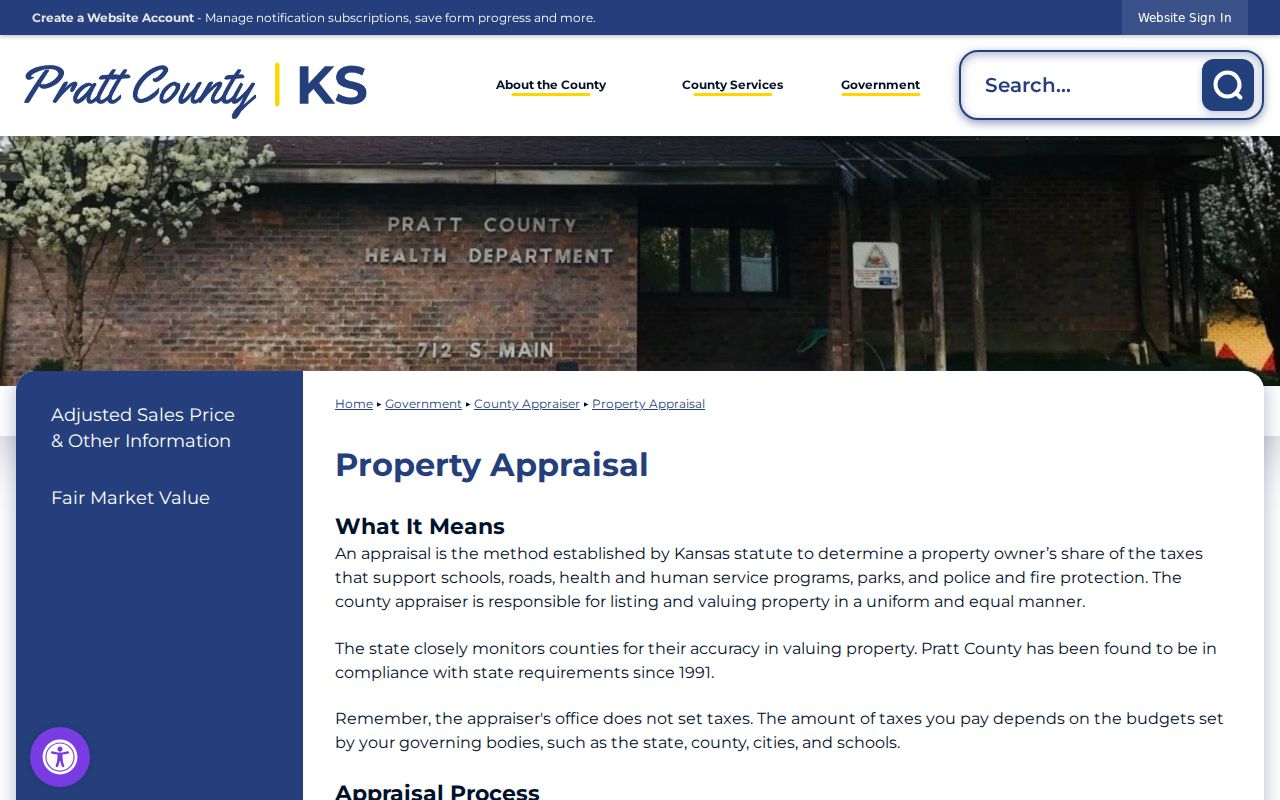
Label every figure with its year and source.
Reconcile Pratt County Value Fields by Year
Set up one row per source and valuation date. Record fair market value, assessed value, land and improvement components, property class, and the parcel number. Add current and prior figures from the annual notice. Keep the sale as a separate transaction fact. When the county supplies an adjusted comparable, keep both the observed sale and its adjustment. Never present the adjusted figure as a deed price.
Comparable columns can grow detailed. They may cover living area by floor, bedrooms, baths, heating and cooling, basement finish, quality, and condition. Garage, porch or deck, land value, building cost, other improvements, distance points, prior value, and indexed value can all appear. This explains why nearby parcels differ. Missing characteristics belong with the Appraiser, not a guess from a map or listing.
A changed figure deserves a sequence of checks. First test whether valuation years, classes, parcel boundaries, or improvement data differ. Then examine the market-study evidence. That sequence explains the record without touching the tax bill or appeal process, which are separate questions.
Interpret Pratt County Market Studies at the Right Scale
Market-study statements work at a group scale. The county's studies and the Kansas Department of Revenue ratio materials describe patterns across many sales that test whether mass-appraisal work tracks the market. They cannot say what one buyer will pay. A countywide ratio should never be multiplied against a single parcel as a shortcut.
Property class matters as much as geography. Residential, commercial and industrial real property, vacant lots, and agricultural land can follow different evidence and statutory treatment. Improvements and land may also move differently. A useful Pratt County property value comparison stays within one class and time period. Check the legal parcel. State whether each figure is a market estimate, assessed amount, sale fact, or adjusted comparable.
Recent headlines deserve the same caution. A reported trend may fit the studied group while a particular parcel moves less, more, or in another direction. Condition, use, construction, demolition, or a corrected record can drive the difference. The parcel's notice and comp data control the explanation.
What a Pratt County Assessor Value Cannot Say
The assessor's figure comes from mass appraisal for taxation. It can trail recent physical or market changes. It also ignores terms a particular buyer and seller might negotiate. A licensed appraisal for a defined purpose is a different product. Even a recent sale needs testing. Check the interest conveyed and the property condition. Also confirm the transaction date, and whether the deal was arm's length and qualified.
Nor does the value record explain the tax amount alone. The Appraiser estimates value. Kansas law supplies classification ratios, while the Clerk maintains levies, taxing districts, and special assessments. The Treasurer bills and collects. Two parcels with similar market estimates can sit in different taxing contexts. Keep the number comparison separate from the tax statement.
Blend the dated county estimate with a physical inspection for purchase planning. Add current market evidence and professional advice. Preserve prior notices and comp sheets, since later screens may show only the newer cycle. Suspect a data error? Ask the Appraiser which characteristics and sales supported the estimate. Don't assume the assessed figure was a sale prediction.
Value is not a sale promise. Pratt County's assessed value serves taxation and is not what a property will sell for. It is not a private appraisal.